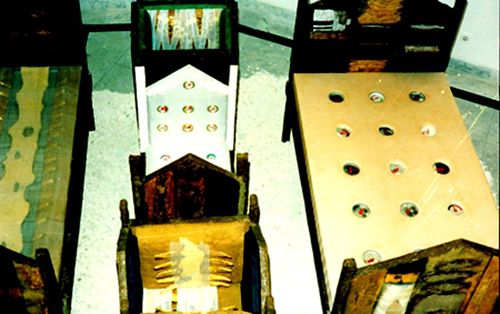
BED & TIME 2002
Installation
Egyptian Youth Salon — Cairo Opera House & Palace of Arts, Cairo, Egypt
Bed & Time investigates the intimate relationship between the human body, memory, and the passage of time through a symbolic reconstruction of domestic space. The installation transforms the bed from an object associated with comfort and rest into an existential structure carrying traces of absence, fragility, isolation, and the gradual erosion of human experience.
The elongated bed-like forms resemble simultaneously pathways, fragile architectural structures, and symbolic bodies suspended between presence and disappearance. Their narrow proportions and repetitive linearity evoke a psychological sense of restriction and temporal continuity, as if the body were trapped within the silent progression of time itself. The surrounding chair-like structures appear less as functional furniture and more as symbolic witnesses to human presence, memory, and absence.
The work approaches time not as chronological measurement, but as an invisible force shaping identity, memory, and emotional experience. Repetition within the installation reflects cycles of waiting, routine, aging, and existential passage. The worn textures and handmade surfaces reinforce the fragility of human existence and the accumulation of psychological traces carried by ordinary domestic objects.
The installation space oscillates between intimacy and alienation. Although the forms resemble familiar household elements, they are stripped of comfort and transformed into contemplative structures charged with silence and emotional tension. The bed becomes simultaneously a site of rest, illness, memory, loneliness, birth, and mortality — a symbolic threshold between the personal and existential dimensions of human life.
Through minimal forms, repetition, and spatial tension, Bed & Time proposes a philosophical meditation on impermanence and the fragile relationship between human existence and time. The work reflects on how memory inhabits objects, how absence becomes materially present, and how the passage of time gradually transforms the most intimate spaces into silent archives of human experience.