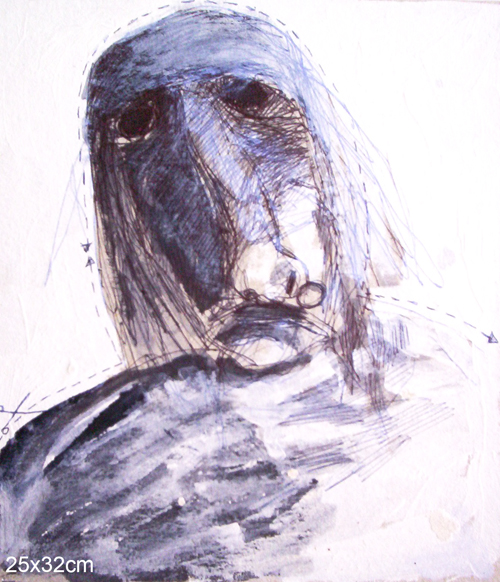
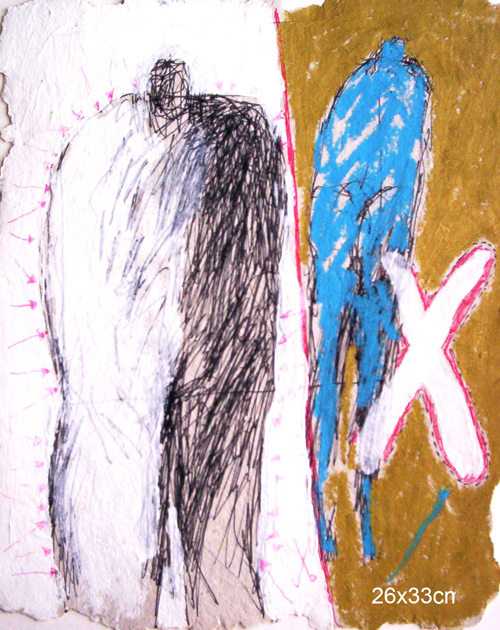
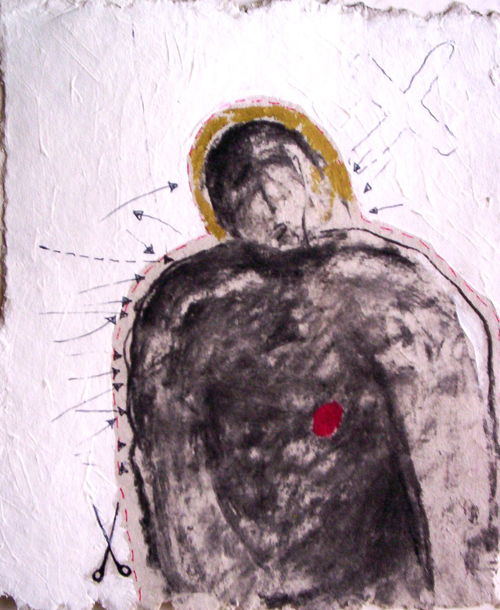
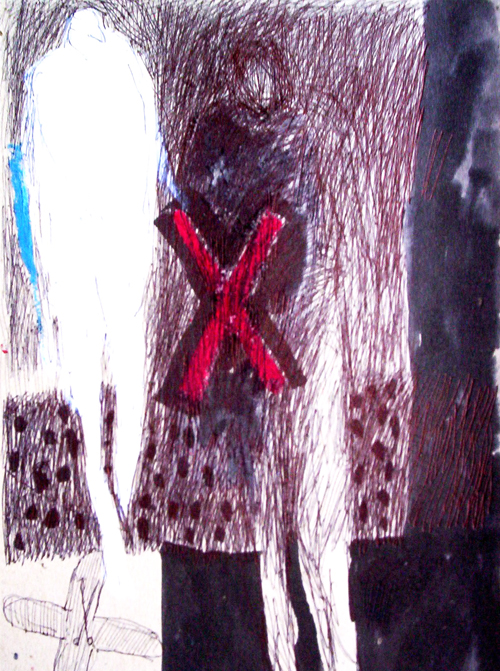
In these early works from 2008, the visual language emerges in a raw and reduced state, where the human figure appears suspended between presence and erasure. The compositions rely on monochromatic structures interrupted only by restrained traces of color, as if color itself is attempting to survive inside a psychologically compressed space. Rather than functioning as descriptive elements, the figures operate as fragile emotional residues moving through silent and undefined territories.
The repetition of isolated bodies, crossed marks, fragmented contours, and vacant backgrounds reflects an early investigation into the instability of identity and the emotional weight of human existence. The absence of spatial certainty transforms the surface into a field of tension where the figure is continuously exposed to disappearance, isolation, and internal conflict. These works do not seek narrative clarity; instead, they construct a psychological atmosphere governed by silence, hesitation, and perceptual ambiguity.
Within this stage, drawing becomes more than a formal practice. Lines behave as nervous traces recording emotional pressure and bodily vulnerability. The rough textures, scratched surfaces, and unfinished gestures reveal an intuitive process where the image remains in a constant state of becoming rather than completion. The restrained use of color intensifies the dramatic presence of black, white, and grey tonalities, creating a visual rhythm oscillating between concealment and revelation.
The works also reveal an early tendency toward symbolic reduction, where the body loses its individual specificity and transforms into a universal sign of psychological exposure. Faces dissolve, bodies blur, and spatial references collapse, allowing the emotional condition itself to dominate the composition. This reduction establishes the foundations of Wael Darweish’s later visual philosophy, where the human figure becomes a carrier of memory, anxiety, absence, and existential uncertainty.
Rather than presenting fixed realities, these paintings function as internal states translated into visual form. The image appears fragile, transient, and unstable — suspended between drawing and erasure, presence and disappearance, silence and expression. Through this minimal yet emotionally charged visual language, the works establish an early philosophical inquiry into the human condition that would continue to evolve throughout the artist’s later projects.