SHROUDED MEMORIES
Artsawa Gallery, Dubai — 2010
The works of 2010 investigate the psychological structure of collective human presence within unstable urban and emotional environments. The project approaches the city not as a physical location, but as a shifting psychological field in which human identity becomes fragile, repetitive, and continuously exposed to states of alienation, surveillance, and emotional displacement.
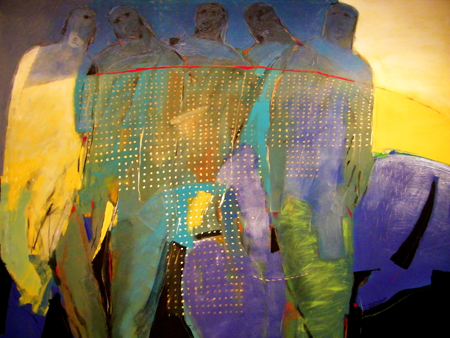
The paintings construct compressed visual spaces populated by anonymous figures, fragmented crowds, and isolated silhouettes suspended between movement and stillness. Human presence appears simultaneously collective and disconnected, as if the figures inhabit the same space physically while remaining emotionally distant from one another. The repeated bodies, shadow-like forms, and partially erased identities transform the image into a reflection on contemporary existence and the instability of social relationships.
Within these works, abstraction emerges directly from the human condition itself. The figures are simplified, dissolved, layered, or partially concealed through broad chromatic fields and painterly interruptions that destabilize the certainty of representation. The body becomes less a portrait of an individual and more a psychological trace shaped by memory, tension, repetition, and emotional accumulation.
Color functions as a structural and emotional language rather than a descriptive device. Expansive planes of red, blue, black, violet, and luminous yellow generate visual tensions oscillating between silence and confrontation, intimacy and estrangement. The chromatic contrasts create theatrical psychological atmospheres in which the figures appear trapped within unstable emotional conditions and fragmented spatial realities.
Photography and lived urban experience inform the visual structure of the project, yet reality is continuously reconstructed through gesture, abstraction, layering, and symbolic transformation. The paintings do not document the city directly; instead, they reinterpret its emotional residue through perceptual fragmentation and psychological distortion. Everyday encounters become suspended visual events charged with ambiguity and emotional pressure.
The compositions reject fixed narrative structure in favor of open perceptual experiences. Figures drift through undefined spaces resembling temporary emotional stages where identity itself appears unstable and continuously shifting. Repetition within the image becomes both a formal rhythm and a metaphor for the psychological cycles embedded in contemporary life.
Through this visual language, the project proposes painting as a space of confrontation between the visible and the concealed, the individual and the collective, memory and immediate experience. The works reveal an early formation of Wael Darweish’s ongoing exploration of emotional instability, fragmented identity, and the transformation of human presence within contemporary visual culture.